Table of contents
- Deran’s Advantages in Customizing Jibbitz Design and Development
- Preparing for Crocs Charm Design: From Inspiration to Digitalization
- Recommended Tools and Materials for Making Crocs Charms
- Crocs Charms Production Process Detailed: From Prototype to Mass Production
- Common Problems and Solutions: Avoiding Common Mistakes
Jibbitz is no longer just an accessory; it’s a crucial tool for brand differentiation, IP commercialization, fan economy, and secondary sales growth.
However, problems have arisen:
- The quality of Crocs Charms on the market varies greatly, with frequent issues like peeling, fading, and cracking.
- Many factories can only produce simple molds, making it difficult to realize complex IPs or high-precision designs.
- Non-compliant materials lead to returns, removal from shelves, and even account suspensions on platforms in Europe and America.
- Small-batch customization is difficult to scale up, while large-volume orders are hard to deliver consistently.
This is precisely why more and more brands are starting to look for truly professional Crocs Charm manufacturers.
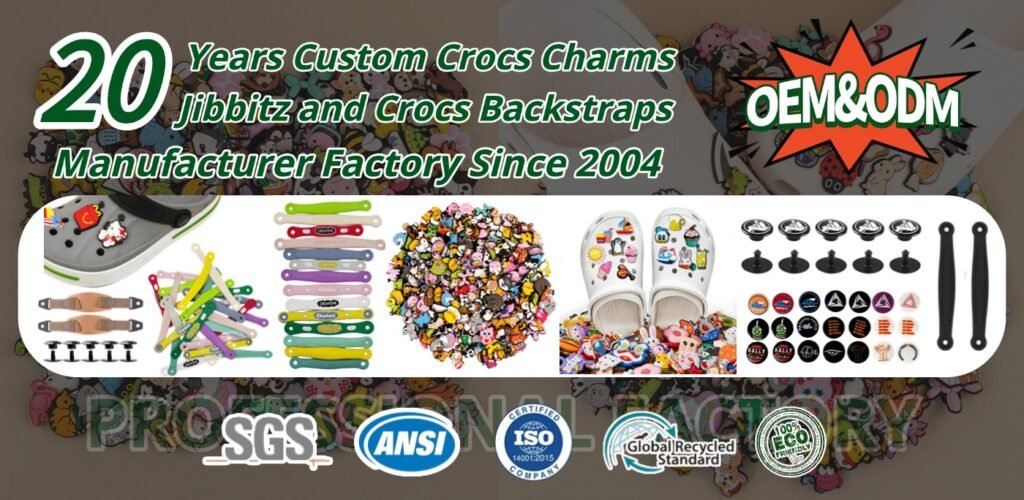
As a croc wholesale suppliers with many years of experience in Crocs footwear and accessories manufacturing, Deran does more than just provide production services; it has built a complete system-level customization capability from design, engineering, materials, manufacturing to delivery.
👉 Why Deran has become a long-term manufacturing partner for Jibbitz’s professional clients
👉 Deran’s real advantages in design, materials, craftsmanship, quality, compliance, and delivery
👉 How to choose a reliable Crocs Charms factory using the right methods
👉 How to truly turn footwear and accessories into a replicable, scalable, and sustainably profitable business
Deran’s Advantages in Customizing Jibbitz Design and Development
Many clients, when looking for Crocs Charms manufacturers, often only focus on price and minimum order quantity, neglecting a core issue:
👉 Can your design actually be manufactured and reliably replicated?
In actual projects, the most common failure for Jibbitz isn’t production, but rather the disconnect between front-end design and engineering.
Common issues include:
- Overly detailed shapes, making injection molding impossible
- Insufficient structural strength, leading to breakage upon wear
- Incorrect buckle dimensions, resulting in unstable installation
- Inaccurate color reproduction
- Distorted IP character proportions, affecting licensing compliance
Deran’s biggest advantage in the design and development phase lies in:
Not just “drawing blueprints and handing them over to the factory,” but building a production-oriented, engineered design system.
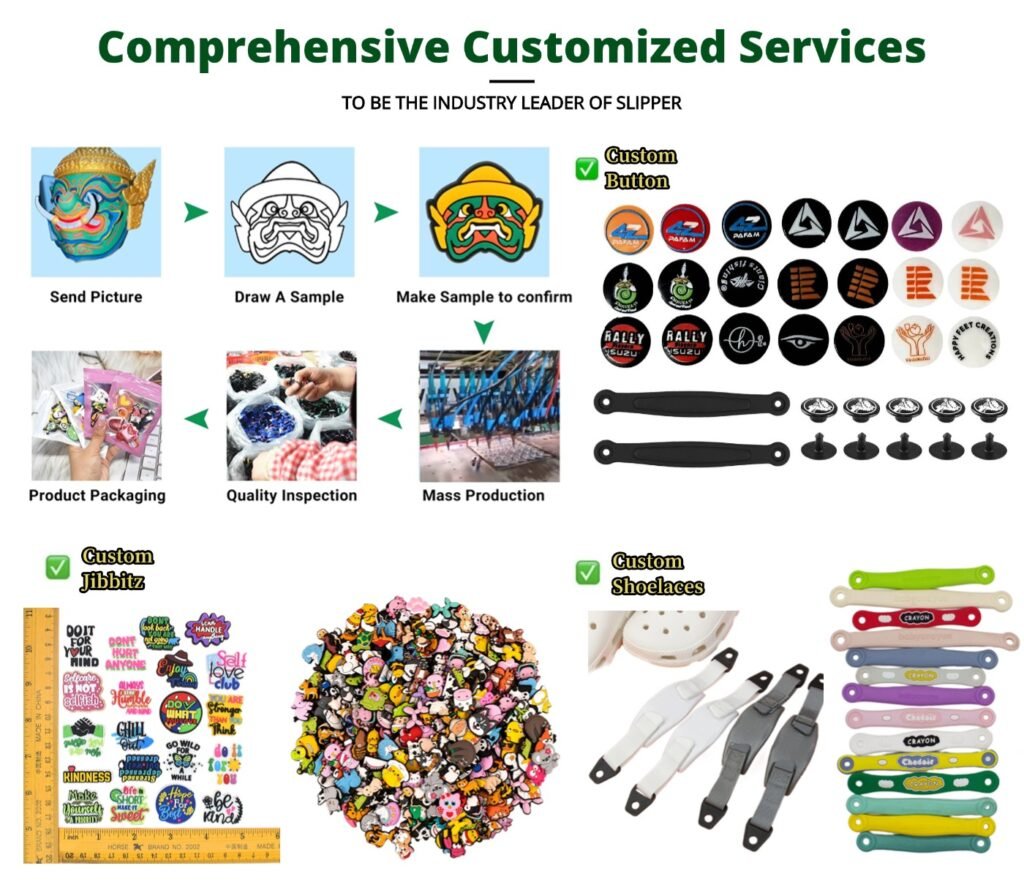
Deran’s Jibbitz Development Process: A Standard Path from Concept to Mass Production
Deran’s standard development process typically includes:
- Client idea or sketch input
- Structural feasibility assessment by industrial design engineers
- 3D modeling and manufacturability optimization (DFM)
- Color layering and material selection recommendations
- Rapid prototyping and wear testing
- Revisions and final engineering design
- Mass mold development and pilot production verification
Steps 3–5 are crucial in determining the success of commercialization.
Deran’s engineering team uses industrial-grade CAD modeling software such as SolidWorks and Autodesk Fusion 360 for structural modeling, combined with mold flow analysis tools (such as Moldflow) to predict:
- Infill path
- Shrinkage rate
- Bubble risk
- Demolding difficulty
- Stress points of snap-fit structures
This engineering design approach ensures that Jibbitz is not just “good-looking,” but truly possesses:
- Stable installation
- Long-term durability
- High replicability
- Industrial-grade structural strength
Deran’s advantages in complex shapes and IP licensing projects
Compared to ordinary shoe and apparel factories that can only produce flat or simplified shapes, Deran excels in:
- Multi-layered three-dimensional structural designs
- High-precision relief and hollow structures
- Multi-material composite molding
- Multi-color simultaneous injection molding or insert structures
- Reproduction of complex forms such as animals, figures, cartoons, and brand logos
This is especially crucial in IP licensing projects.
IP owners typically have strict specifications regarding product fidelity, safety compliance, size proportions, and brand colors.
Deran’s engineering team is able to:
- Embeddefine IP usage guidelines (Brand Style Guide) during the design phase
- Control minimum line widths and corner radii to ensure both faithful reproduction and mass production feasibility
- Shorten approval cycles through sample making and IP review processes
- Proactively mitigate structural risks and compliance issues related to infringement
This has made Deran a long-term footwear and apparel manufacturing partner for numerous IP project clients.
Preparing for Crocs Charm Design: From Inspiration to Digitalization
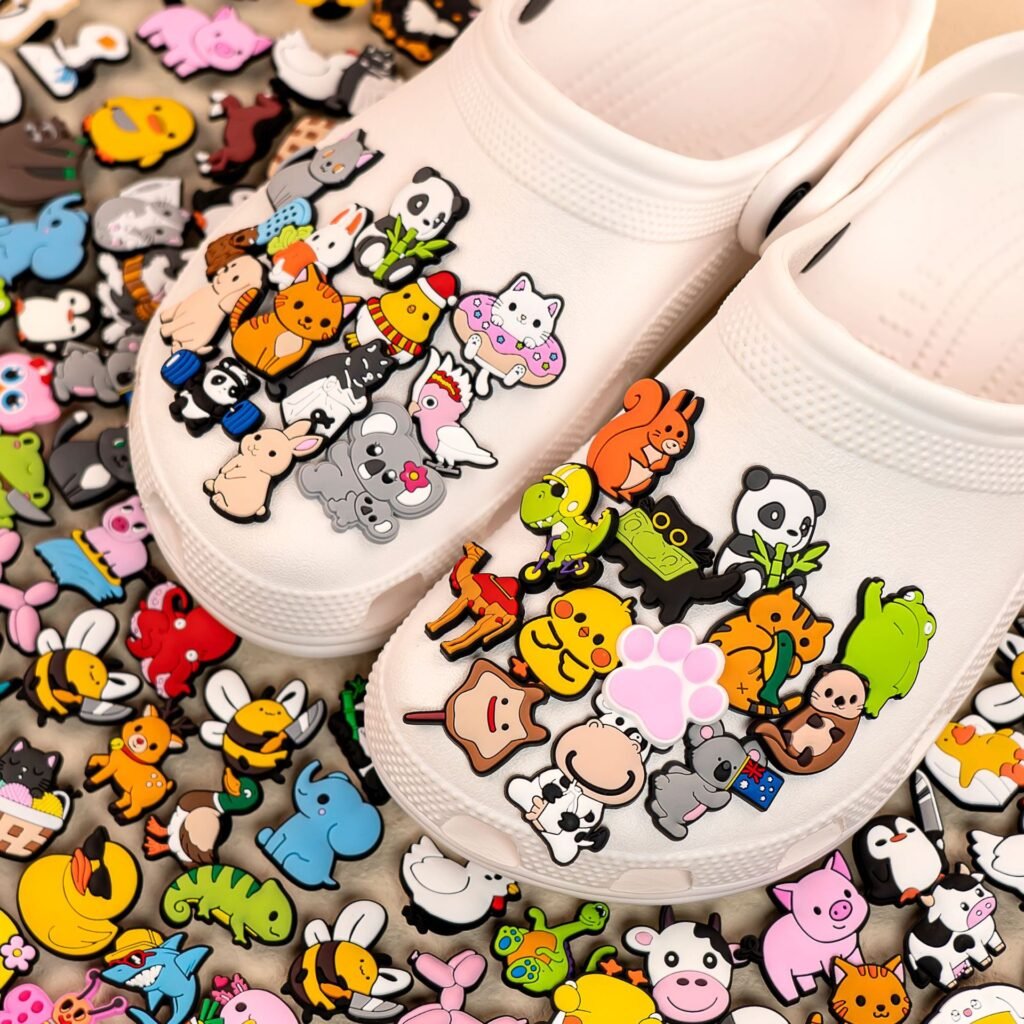
The first step in making Crocs Charms is design. Even the best materials won’t capture attention without a creative design.
Sources of Inspiration
Design inspiration can be obtained from the following sources:
- Pinterest & Instagram: Search keywords like “crocs charms aesthetic” and “kawaii charms design” to access the latest global style trends.
- Etsy Hot Seller Analysis: Understand market preferences by observing popular designs and customer reviews on Etsy.
- TikTok Trends: Focus on topics young people are discussing, such as cartoon characters, buzzwords, and rising idols.
Drawing Tools
- Beginner Recommendation: Hand-drawn sketches + mobile phone photography + simple Photoshop editing.
- Expert Recommendation: Use Procreate (iPad) or Adobe Illustrator for vector drawing, which will facilitate mold precision control in the later stages.
Design Key Points
- Size Control: Main images should ideally be kept within 3cm; width should not exceed 3.2cm, otherwise they may fall off.
- Content Composition: Avoid overly thin structures (such as thin, long whiskers), as they can break easily.
- Color Combination: Refer to Pantone color charts or Adobe Color to create a combination of highly saturated, clearly defined color blocks.
After establishing a character or pattern library, you can move on to the proofing stage. It’s also recommended to develop multiple themes, such as holiday collections, animal collections, and trendy collections, to increase market reach.
Recommended Tools and Materials for Making Crocs Charms
Once the design is complete, you need to prepare the materials and tools to begin production. This section will cover both manual and digital production.
Common Materials List
| Material | Properties | Applicable Categories |
| PVC Soft Rubber | Soft, colorable, low-cost | Injection Molding |
| TPU Plastic | Strong elasticity, high transparency | Pin structure |
| PU Epoxy | Waterproof, surface gloss protection | Epoxy Decorations |
| Acrylic Sheet | Laser-cuttable | Laser Finish |
| Resin | High hardness, dyeable | Handmade in small batches |
Crocs Charms Production Process Detailed: From Prototype to Mass Production
Single Prototype Process
- Import the design into modeling software for 3D modeling.
- Use 3D printing or silicone molds for preliminary molding.
- Inject color or coating for appearance testing.
- Attach to the pin base for secure fit verification.
Color Matching and Mold Development
- Use the Pantone color matching system for color matching.
- Mold costs range from approximately 500 to 1500 yuan per design, depending on the complexity of the design.
- Most manufacturers require a minimum order of 50-100 pieces before starting mold production.
Surface Treatment
- Glossy Finish: Conventional polishing or injection molding for a natural gloss.
- Epoxy Cover: Creates a mirror-like look and feel.
- Matt UV Spray: Anti-fingerprint and scratch-resistant.
Volume Production Recommendations
- Minimum Order Quantity (MOQ): The standard MOQ is 500 pieces per style, though some smaller factories may accept orders of 100 pieces.
- Production Lead Time: From proofing to delivery, it typically takes 15-20 days.
- Quality Inspection: Includes tensile testing (to ensure pins resist falling off), color fastness testing (to prevent sun fading), and environmental certification (RoHS/REACH, etc.).
Common Problems and Solutions: Avoiding Common Mistakes
Pins Breaking Easily?
- Cause: The pin material is too hard or the base thickness is improperly designed.
- Solution: Use flexible TPU material, with a recommended thickness of no more than 2.5mm.
Excessive Color Deviation?
- Cause: Inaccurate color matching or large batch variations.
- Solution: Record the color ratio for each batch and use Pantone color charts for comparison and calibration.
Is the mold prone to wear?
- Cause: Lack of maintenance or overly complex design.
- Solution: Regularly oil the mold after use, store in a dry environment, and separate complex designs into separate pieces.
Is the customer’s design suspected of copyright infringement?
- We recommend that the customer sign a design authorization statement to avoid counterfeiting well-known brands or character IPs.
Unable to export to Europe or the United States?
- We recommend applying for relevant certifications (such as CE Mark, EN71, ASTM-F963) in advance and requesting safety reports from material suppliers.
| OEM&ODM Factory | Email: sarah@clogsslipper.com | Whatapp: +8613960916317 |
Wholesale custom jibbitz are more than just decoration; they are a form of self-expression. Once you master the entire process from design to production, you can not only create your own unique accessories but also develop them into a marketable, creative, and profitable brand project.
Whether you are a solo creator, a micro-business owner, or a startup brand, with patience, creativity, and the right approach, Crocs Charms will be a promising creative path.
Now, it’s time to start working on your first design.